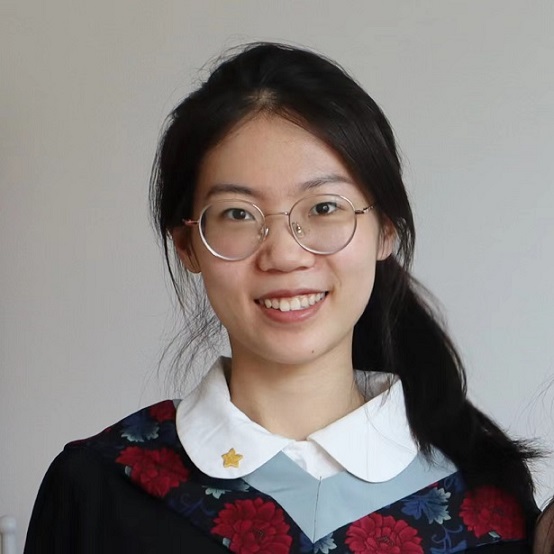
About me
Hello! I am a fifth-year PhD candidate at UC Berkeley, working with Prof. Laura Waller. I started my graduate studies in 2022 after graduating with a B.S. in Electrical Engineering from Peking University, China.
My research focuses on developing and applying advanced computational imaging techniques, with expertise in signal processing, optimization algorithms, and their applications in image reconstruction and aberration characterization. Previously, I worked on non-line-of-sight imaging with Prof. Andreas Velten. I have also spent summers at Meta Reality Labs working on holographic displays for AR glasses and at ASML working on source-mask optimization for lithography, and I currently hold an imaging residency with Biohub. I play with signal processing in the Fourier domain a lot, and I always love combining physical hardware and computational methods to create something new.
Projects
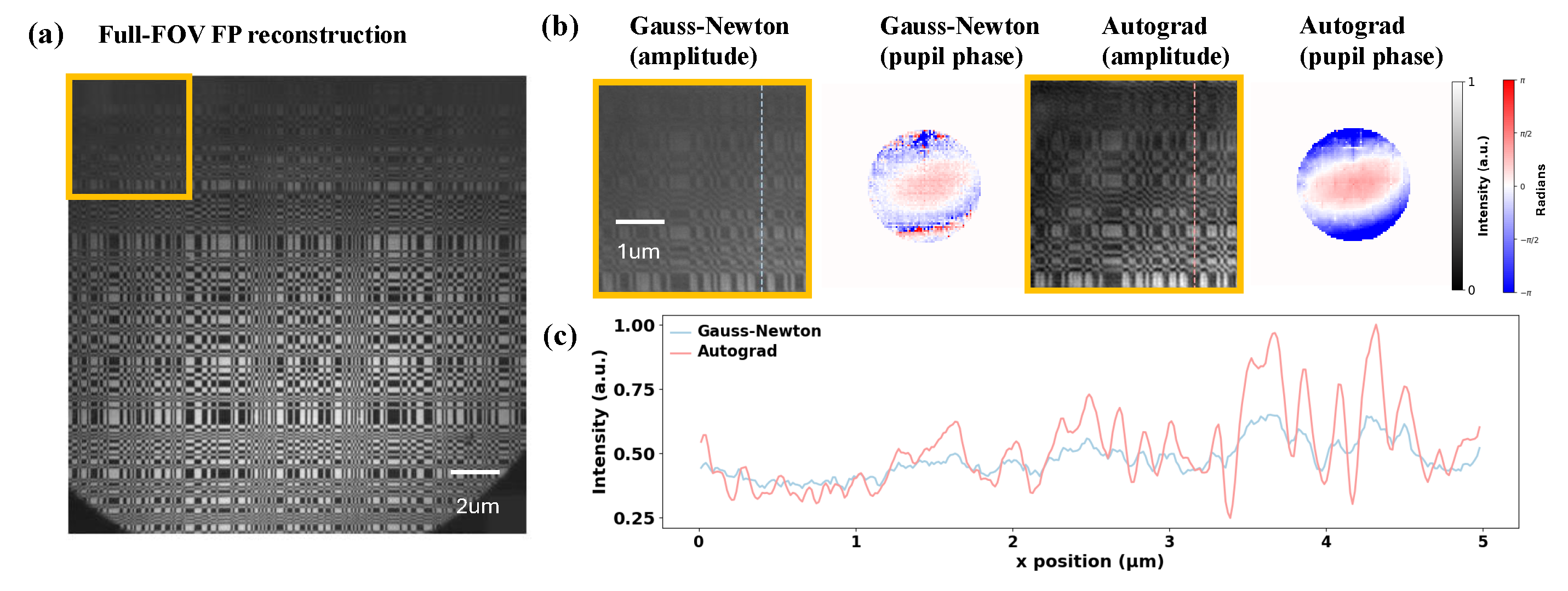
Enhanced EUV Mask Imaging using Fourier Ptychographic Microscopy
- Extensively evaluated reconstruction quality of existing algorithms under EUV microscope aberration and achieved a 36-fold increase in the usable field-of-view from the nominal 5×5 μm² diffraction-limited area.
- Developed an automatic differentiation framework for system self-calibration and wavefront error correction, enabling robust reconstruction of elliptical pupils and attenuated phase shift masks.
- Validated Fourier FPM as a promising technique for advanced EUV mask imaging, achieving quantitative phase recovery and through-focus simulation using experimental data from the SHARP EUV microscope at Lawrence Berkeley National Laboratory.
- Predicted lithographic process windows and optimized illumination for high-NA anamorphic imaging.
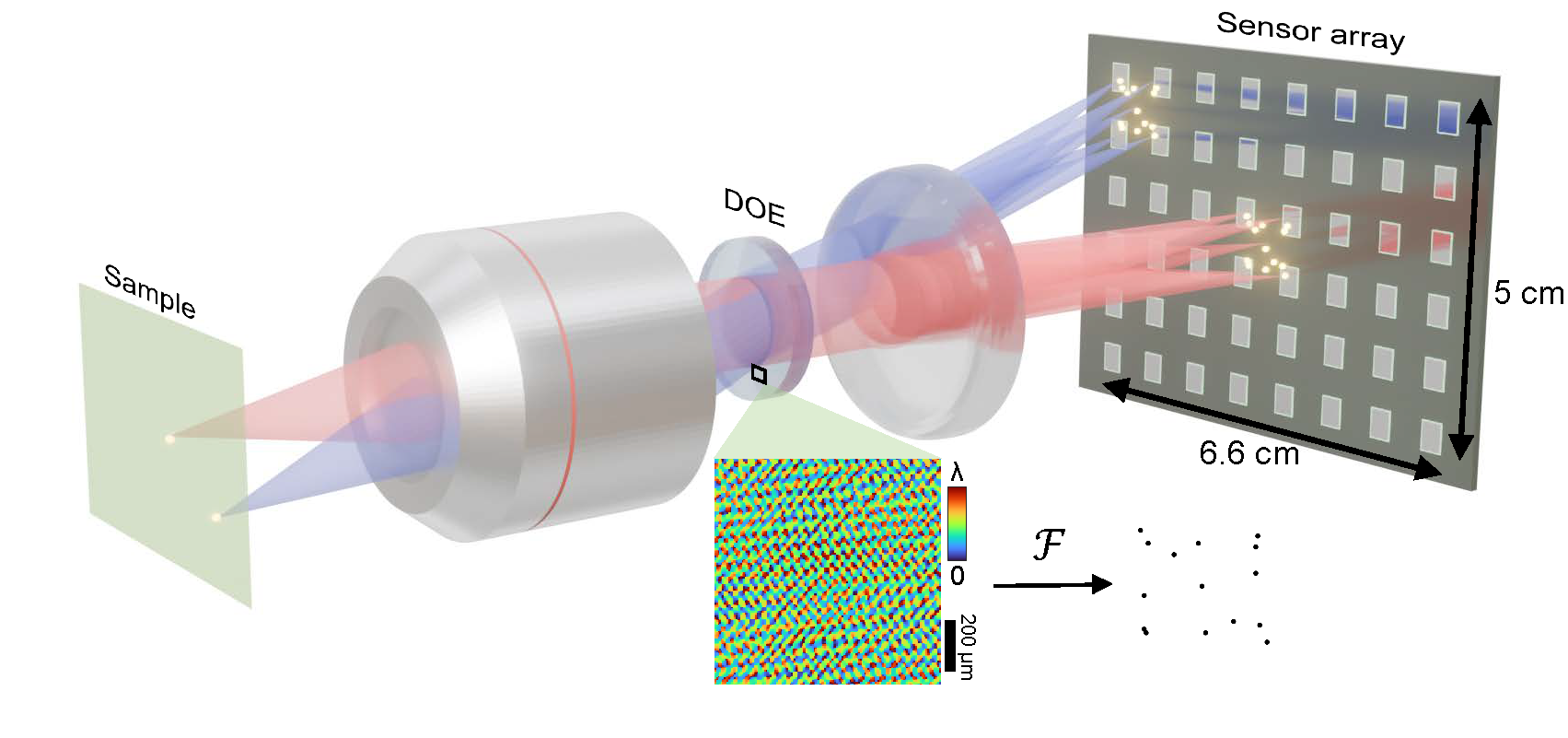
Large-scale Compressive Microscopy via Diffractive Multiplexing across a Sensor Array
- Developed a computational microscope using a sensor array and a diffractive optical element (DOE) to achieve high-throughput imaging, covering a 5 cm × 6.6 cm region with ~0.6 gigapixels.
- Developed the patch-based memory-efficient reconstruction algorithm involving deconvolution of diffraction patterns to fill in sensor gaps, with a fully shift-variant forward model and GPU acceleration.
- Trained an end-to-end neural network to accelerate the optimization-based video reconstruction, using a patch-based strategy with Fourier convolution kernels to scale to gigapixel reconstructions of freely moving organisms.
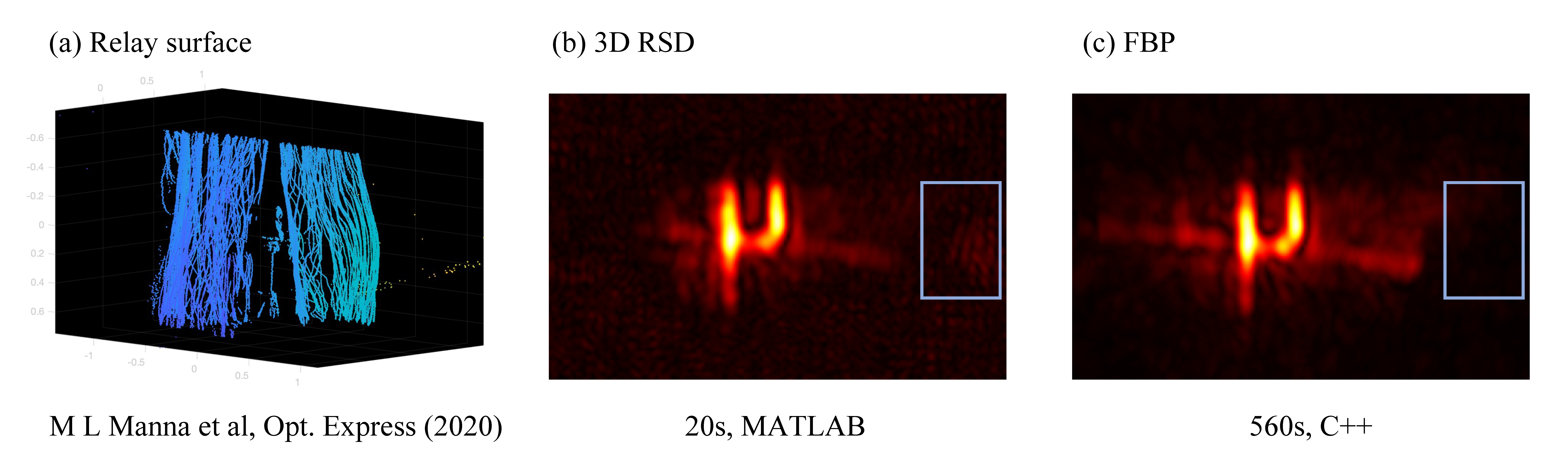
Fast Non-line-of-sight Imaging with Non-planar Relay Surfaces
- Proposed a novel computational method that effectively performs 3D diffraction propagation for arbitrary non-planar surfaces.
- Achieved orders of magnitude better complexity compared to state-of-the-art algorithms without quality degradation, validated on experimental data.
Ongoing Work
Pre-trained Diffusion Models for Optimization-Guided Deconvolution with Large Kernels
- Applied current diffusion posterior sampling methods (DPS, Red-Diff, DDNM, EDM) to deconvolution problems with diffuser PSFs, identifying significant hallucination issues in existing methods.
- Investigating an optimization-inspired purification method to alleviate the trade-off between visual plausibility and measurement data fidelity.
Automatic Regularization for Label-Free Computational Microscopy
- Learning regularization parameters directly from the raw measurements, removing hand-tuning from the reconstruction pipeline.
- Scaling waveOrder, a computational framework for label-free imaging, to larger and more diverse datasets.